 ROBERT B. REICH, Chancellor’s Professor of Public Policy at the University of California at Berkeley and Senior Fellow at the Blum Center for Developing Economies, was Secretary of Labor in the Clinton administration. Time Magazine named him one of the ten most effective cabinet secretaries of the twentieth century. He has written thirteen books, including the best sellers “Aftershock" and “The Work of Nations." His latest, "Beyond Outrage," is now out in paperback. He is also a founding editor of the American Prospect magazine and chairman of Common Cause. His new film, "Inequality for All," is now available on Netflix, iTunes, DVD, and On Demand.
+ FOLLOW ON TUMBLR + TWITTER + FACEBOOK
-
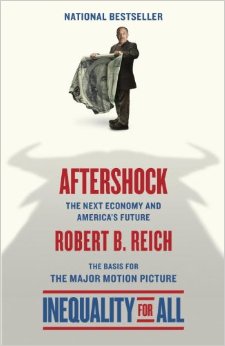
Aftershock
The Next Economy and America's Future
Buy this book at:
Amazon iBookstore BN.com Indiebound Powells RandomHouse -
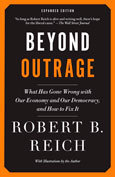
New Editions Available Now
Beyond Outrage:
What has gone wrong with our economy and our democracy, and how to fix itPreorder the Trade Paperback:
BN.com IndieBound Amazon RandomHouse
Preorder the Expanded eBook:
Amazon iBookstore BN.com RandomHouse
Preorder the Expanded, Enhanced eBook (w/ videos):
Amazon iBookstore BN.com
-

Supercapitalism
The Transformation of Business, Democracy, and Everyday Life
Buy this book at:
Amazon iBookstore BN.com Indiebound Powells RandomHouse -

Reason
Why Liberals Will Win the Battle for America
Buy this book at:
Amazon iBookstore BN.com Indiebound Powells RandomHouse -

Locked in the Cabinet
A memoir of four years as Secretary of Labor
Buy this book at:
Amazon BN.com Powells Indiebound RandomHouse

COLBERT REPORT, NOVEMBER, 2013

WITH BILL MOYERS, SEPT. 2013

DAILY SHOW, SEPTEMBER 2013, PART 1

DAILY SHOW, SEPTEMBER 2013, PART 2

DEMOCRACY NOW, SEPTEMBER 2013

INTELLIGENCE SQUARED DEBATES, SEPTEMBER 2012

DAILY SHOW, APRIL 2012, PART 1

DAILY SHOW, APRIL 2012, PART 2

COLBERT REPORT, OCTOBER, 2010

WITH CONAN OBRIEN, JANUARY, 2010

DEBATING RON PAUL, JANUARY, 2010

DAILY SHOW, OCTOBER 2008

DAILY SHOW, APRIL 2005

DAILY SHOW, JUNE 2004
Nike, Obama, and the Fiasco of the Trans Pacific Partnership
Friday, May 8, 2015
On Friday, President Obama chose Nike headquarters in Oregon to deliver a defense of his proposed Trans-Pacific Partnership.
It was an odd choice of venue.
Nike isn’t the solution to the problem of stagnant wages in America. Nike is the problem.
It’s true that over the past two years Nike has added 2,000 good-paying professional jobs at its Oregon headquarters, fulfilling the requirements of a controversial tax break it wrangled from the state legislature. That’s good for Nike’s new design, research and marketing employees.
Just before the President spoke, Nike announced that if the Trans Pacific Partnership is enacted, Nike would “accelerate development of new advanced manufacturing methods and a domestic supply chain to support U.S. based manufacturing,” thereby creating as many as 10,000 more American jobs.
But that would still be only a tiny fraction of Nike’s global workforce. While Nike makes some shoe components in the United States, it hasn’t assembled shoes here since 1984.
Americans made only 1 percent of the value of Nike products that generated Nike’s $27.8 billion revenue last year. And Nike is moving ever more of its production abroad. Last year, a third of Nike’s remaining 13,922 American production workers were laid off.
Most of Nike’s products are made by 990,000 workers in low-wage countries whose abysmal working conditions have made Nike a symbol of global sweatshop labor.
As wages have risen in China, Nike has switched most of its production to Vietnam where wages are less than 60 cents are hour. Almost 340,000 workers cut and assemble Nike products there.
In other words, Nike is a global corporation with no particular loyalty or connection to the United States. Its loyalty is to its global shareholders.
I’m not faulting Nike. Nike is only playing by the rules.
I’m faulting the rules.
In case you hadn’t noticed, America has a huge and growing problem of inequality. Most Americans are earning no more than the typical American earned thirty years ago, adjusted for inflation – even though the U.S. economy is almost twice as large as it was then.
Since then, almost all the economic gains have gone to the top.
The President is angry at Democrats who won’t support this trade deal.
He should be angry at Republicans who haven’t supported American workers. Their obduracy has worsened the potential impact of the deal.
Congressional Republicans have refused to raise the minimum wage (whose inflation-adjusted value is now almost 25 percent lower than it was in 1968), expand unemployment benefits, invest in job training, enlarge the Earned Income Tax Credit, improve the nation’s infrastructure, or expand access to public higher education.
They’ve embraced budget austerity that has slowed job and wage growth. And they’ve continued to push “trickle-down” economics – keeping tax rates low for America’s richest, protecting their tax loopholes, and fighting off any attempt to raise taxes on wealthy inheritances to their level before 2000.
Now they – and the President – want a huge trade agreement that protects corporate investors but will lead to even more off-shoring of low-skilled American jobs.
The Trans Pacific Trade Partnership’s investor protections will make it safer for firms to relocate abroad – the Cato Institute describes such protections as “lowering the risk premium” on offshoring – thereby reducing corporate incentives to keep jobs in America and upgrade the skills of Americans.
Those same investor protections will allow global corporations to sue the United States or any other country that raises its health, safety, environmental, or labor standards, for any lost profits due to those standards.
But there’s nothing in the deal to protect the incomes of Americans.
We know that when Americans displaced from manufacturing jobs join the glut of Americans competing for jobs that can’t be replaced by lower-wage workers abroad – personal service jobs in retail, restaurant, hotel, hospital, child care, and elder care – all lower-skilled workers face downward pressure on wages.
Jobs being lost to imports pay Americans higher wages than the jobs left behind. Government data show wages in import-competing industries (e.g. manufacturing jobs) beat those in exporting industries overall.
Without a higher minimum wage, an expanded Earned Income Tax Credit, affordable higher education, and a world-class system of job retraining – financed by higher taxes on the wealthy winners in the American economy – most Americans will continue to experience stagnant or declining wages.
Instead, the Trans Pacific Partnership – which includes twelve nations, including Vietnam, but would be open for every nation to join – would lock us into an expanded version of the very policies that have failed most American for the past twenty years.
No doubt Nike is supporting the TPP. It would allow Nike to import its Vietnamese and Malaysian-made goods more cheaply. But don’t expect those savings to translate into lower prices for American consumers. As it is, Nike spends less than $10 for every pair of $100-plus shoes it sells in the U.S.
Needless to say, the TPP wouldn’t require Nike to pay its Vietnamese workers more. Nikes’ workers are not paid enough to buy the shoes they make much less buy U.S. exported goods.
Nike may be the perfect example of life under TPP, but that is not a future many Americans would choose.

STEP #2: MAKE WORK FAMILY FRIENDLY
No one should have to choose between providing for your family and being a good parent. Yet “family-friendly” work is still a pipedream.
Today most parents are also wage earners, whether in a two-parent or single-parent household. Politicians talk a lot about the importance of family, but must do a better job delivering.
Specifically:
– Require that women receive equal pay for equal work.
– Require employers provide predictable hours so workers can plan to be home when their family needs them.
– Provide universal childcare – pre-school and after-school – financed by employers and taxpayers.
– Require that employers offer paid family and medical leave.
The richest nation in the world should enable its workers to be good parents. Family-friendly work isn’t a luxury. People who work hard deserve to make more than a decent living. They and their families deserve a decent life.
MAKING THE ECONONY WORK FOR THE MANY, NOT THE FEW. STEP #1: RAISE THE MINIMUM WAGE
A basic moral principle that most Americans agree on is no one who works full time should be in poverty, nor should their family.
Yet over time we’ve seen significant growth in the “working poor” – people working full time, sometimes even 60 or more hours each week, but at such low wages that they remain impoverished.
What to do?
One step is to raise the minimum wage to $15 an hour. This is winnable. A powerful movement is fighting for $15 an hour and they’re winning new laws in cities and states, and forcing companies to raise wages.
If the minimum wage in 1968 had simply kept up with inflation it would be more than $10 today. If it also kept up with the added productivity of American workers since then, it would be more than $21 an hour.
Some opponents say minimum wage workers are teenagers seeking some extra pocket money.
Wrong. Half are 35 or older, and many are key breadwinners for their families.
And don’t believe scaremongers who say a $15 minimum will cause employers to cut employment.
More money in people’s pockets means more demand for goods and services, which means more jobs not fewer jobs.
Studies also show that when the minimum is raised more people are brought into the pool of potential employees, giving employers more choice of whom to hire. This reduces turnover and helps employers save money.
Finally, employers who don’t pay enough to lift their employees out of poverty are indirectly subsidized by the rest of us – who are paying billions each year in food stamps, Medicaid, housing assistance, and welfare, to make up the difference.
The minimum wage should be raised to $15 an hour. It’s the least that a decent society should require.
Trans Pacific Trickle-Down Economics
Saturday, May 2, 2015
Have we
learned nothing from thirty years of failed trickle-down economics?
By now we should know that when big corporations, Wall Street, and the wealthy get special goodies, the rest of us get shafted.
The Reagan and George W. Bush tax cuts of 1981, 2001, and 2003, respectively, were sold to America as ways to boost the economy and create jobs.
They ended up boosting the take-home pay of those at the top. Most Americans saw no gains.
In fact, the long stagnation of American wages began with Reaganomics. Wages rose a bit under Bill Clinton, and then started plummeting again under George W. Bush.
Trickle-down economics proved a cruel hoax. The new jobs created under Reagan and George W. Bush paid lousy wages, the old jobs paid even less, and we ended up with whopping federal budget deficits.
Then came the bailout of Wall Street in 2008. It was sold as the means of preserving the economy.
It ended up preserving the jobs and exorbitant pay of bankers, but millions of Americans lost their shirts. Small savers were wiped out, and homeowners never got the refinancing they were promised.
No conditions were put on the Wall Street banks for what they were supposed to do for the rest of us in return for our bailing them out. None of their top executives even went to jail for causing the crash in the first place.
Here again, nothing trickled down.
Now comes the Trans Pacific Partnership.
It’s being sold as a way to boost the U.S. economy, expand exports, and contain China’s widening economic influence.
In fact, it’s just more trickle-down economics.
The biggest beneficiaries would be giant American-based global corporations, along with their executives and major shareholders.
Those giant corporations initiated the deal in the first place, their lobbyists helped craft it behind closed doors, and they’re the ones who have been pushing hard for it in Congress – dangling campaign contributions in front of congressional supporters and threatening to cut off funding to opponents.
These corporations made sure the deal contains provisions expanding and protecting their intellectual property around the world, but not protecting American jobs.
Supporters of the deal say it contains worker protections. I heard the same thing when, as secretary of labor, I was supposed to implement the worker protections in the North American Free Trade Act.
I discovered such provisions are unenforceable because of how difficult it is to discover if other nations are abiding by them. On the rare occasion when we found evidence of a breach we had no way to force the other nation to remedy it anyway.
The Trans Pacific Partnership is far larger than NAFTA – covering 40 percent of America’s global trade.
If it’s enacted, American workers and consumers will be made even worse off because of another provision that allows global corporations to sue countries whose health, safety, labor, or environmental regulations crimp their corporate profits.
It establishes a tribunal outside any nation’s legal system that can force a nation to reimburse global corporations for any such “losses.”
Big tobacco is already using an identical provision to sue developing nations that are trying to get their populations off nicotine. The tobacco companies are demanding these nations compensate them for lost cigarette sales.
This provision would mean less protection from corporate harms here in America. It would require that when the potential cost of a new health, safety, environment, or labor protection is weighed against its potential benefits, the cost of reimbursing corporations for lost profits is added in.
I’ve been through enough regulatory wars to know this added cost could easily tip the balance against protection.
The arguments in favor of the deal aren’t credible. The notion that the Trans Pacific Partnership will spark American exports doesn’t hold because the deal does nothing to prevent other nations from manipulating their currencies in order to boost their own exports.
The argument that the deal will help contain China makes even less sense.
Does anyone seriously believe American-based corporations will put the interest of the United States above the interests of their own shareholders when it comes to doing whatever China demands to gain access to that lucrative market?
Big American-based corporations have been cozying up to China for years – giving China whatever American technology China wants, letting China “partner” with them in designing new generations of technology, and allowing China to censor their software and digital platforms – all in exchange for a crack at Chinese consumers.
What we should have learned by now about trickle-down economics is that nothing trickles down.
If the Trans Pacific Partnership is enacted, big corporations, Wall Street, and their top executives and shareholders will make out like bandits. Who will the bandits be stealing from? The rest of us.
YOU MUST TAKE ACTION NOW
The heinous Trans Pacific Partnership is now moving in Congress. It’s not really about trade – most tariffs are now low – but about making the world safer for global corporations. It allows big global corporations to sue countries for health, safety, environmental, and labor protections that reduce corporate profits. Its so-called labor and environmental protections are unenforceable. And rather than strengthen America’s hand against China (as its proponents claim), it only strengthens the hands of giant American-based corporations – whose loyalty is to their shareholders rather than to the United States. (These corporations will do whatever China wants if it helps their bottom lines.)
It’s a bad deal for Americans. Please call your senators and your representative and tell them you don’t want the Trans Pacific Partnership, and you don’t want “fast-track” that allows it to speed through Congress without debate or amendment.
The Political Roots of Widening Inequality
Friday, May 1, 2015
For the past quarter-century I’ve offered in articles, books, and lectures an explanation for why average working people in advanced nations like the United States have failed to gain ground and are under increasing economic stress: Put simply, globalization and technological change have made most of us less competitive. The tasks we used to do can now be done more cheaply by lower-paid workers abroad or by computer-driven machines.
My solution—and I’m hardly alone in suggesting this—has been an activist government that raises taxes on the wealthy, invests the proceeds in excellent schools and other means people need to become more productive, and redistributes to the needy. These recommendations have been vigorously opposed by those who believe the economy will function better for everyone if government is smaller and if taxes and redistributions are curtailed.
While the explanation I offered a quarter-century ago for what has happened is still relevant—indeed, it has become the standard, widely accepted explanation—I’ve come to believe it overlooks a critically important phenomenon: the increasing concentration of political power in a corporate and financial elite that has been able to influence the rules by which the economy runs. And the governmental solutions I have propounded, while I believe them still useful, are in some ways beside the point because they take insufficient account of the government’s more basic role in setting the rules of the economic game.
Worse yet, the ensuing debate over the merits of the “free market” versus an activist government has diverted attention from how the market has come to be organized differently from the way it was a half-century ago, why its current organization is failing to deliver the widely shared prosperity it delivered then, and what the basic rules of the market should be. It has allowed America to cling to the meritocratic tautology that individuals are paid what they’re “worth” in the market, without examining the legal and political institutions that define the market. The tautology is easily confused for a moral claim that people deserve what they are paid. Yet this claim has meaning only if the legal and political institutions defining the market are morally justifiable.
II
Most fundamentally, the standard explanation for what has happened ignores power. As such, it lures the unsuspecting into thinking nothing can or should be done to alter what people are paid because the market has decreed it.
The standard explanation has allowed some to argue, for example, that the median wage of the bottom 90 percent—which for the first 30 years after World War II rose in tandem with productivity—has stagnated for the last 30 years, even as productivity has continued to rise, because middle-income workers are worth less than they were before new software technologies and globalization made many of their old jobs redundant. They therefore have to settle for lower wages and less security. If they want better jobs, they need more education and better skills. So hath the market decreed.
Yet this market view cannot be the whole story because it fails to account for much of what we have experienced. For one thing, it doesn’t clarify why the transformation occurred so suddenly. The divergence between productivity gains and the median wage began in the late 1970s and early 1980s, and then took off. Yet globalization and technological change did not suddenly arrive at America’s doorstep in those years. What else began happening then?
Nor can the standard explanation account for why other advanced economies facing similar forces of globalization and technological change did not succumb to them as readily as the United States. By 2011, the median income in Germany, for example, was rising faster than it was in the United States, and Germany’s richest 1 percent took home about 11 percent of total income, before taxes, while America’s richest 1 percent took home more than 17 percent. Why have globalization and technological change widened inequality in the United States to a much greater degree?
Nor can the standard explanation account for why the compensation packages of the top executives of big companies soared from an average of 20 times that of the typical worker 40 years ago to almost 300 times. Or why the denizens of Wall Street, who in the 1950s and 1960s earned comparatively modest sums, are now paid tens or hundreds of millions annually. Are they really “worth” that much more now than they were worth then?
Finally and perhaps most significantly, the market explanation cannot account for the decline in wages of recent college graduates. If the market explanation were accurate, college graduates would command higher wages in line with their greater productivity. After all, a college education was supposed to boost personal incomes and maintain American prosperity.
To be sure, young people with college degrees have continued to do better than people without them. In 2013, Americans with four-year college degrees earned 98 percent more per hour on average than people without a college degree. That was a bigger advantage than the 89 percent premium that college graduates earned relative to non-graduates five years before, and the 64 percent advantage they held in the early 1980s.
But since 2000, the real average hourly wages of young college graduates have dropped. The entry-level wages of female college graduates have dropped by more than 8 percent, and male graduates by more than 6.5 percent. To state it another way, while a college education has become a prerequisite for joining the middle class, it is no longer a sure means for gaining ground once admitted to it. That’s largely because the middle class’s share of the total economic pie continues to shrink, while the share going to the top continues to grow.
III
A deeper understanding of what has happened to American incomes over the last 25 years requires an examination of changes in the organization of the market. These changes stem from a dramatic increase in the political power of large corporations and Wall Street to change the rules of the market in ways that have enhanced their profitability, while reducing the share of economic gains going to the majority of Americans.
This transformation has amounted to a redistribution upward, but not as “redistribution” is normally defined. The government did not tax the middle class and poor and transfer a portion of their incomes to the rich. The government undertook the upward redistribution by altering the rules of the game.
Intellectual property rights—patents, trademarks, and copyrights—have been enlarged and extended, for example. This has created windfalls for pharmaceuticals, high tech, biotechnology, and many entertainment companies, which now preserve their monopolies longer than ever. It has also meant high prices for average consumers, including the highest pharmaceutical costs of any advanced nation.
At the same time, antitrust laws have been relaxed for corporations with significant market power. This has meant large profits for Monsanto, which sets the prices for most of the nation’s seed corn; for a handful of companies with significant market power over network portals and platforms (Amazon, Facebook, and Google); for cable companies facing little or no broadband competition (Comcast, Time Warner, AT&T, Verizon); and for the largest Wall Street banks, among others. And as with intellectual property rights, this market power has simultaneously raised prices and reduced services available to average Americans. (Americans have the most expensive and slowest broadband of any industrialized nation, for example.)
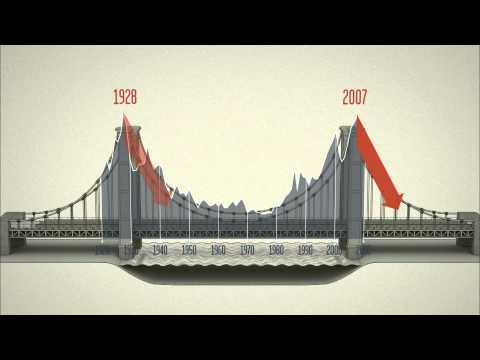
Financial laws and regulations instituted in the wake of the Great Crash of 1929 and the consequential Great Depression have been abandoned—restrictions on interstate banking, on the intermingling of investment and commercial banking, and on banks becoming publicly held corporations, for example—thereby allowing the largest Wall Street banks to acquire unprecedented influence over the economy. The growth of the financial sector, in turn, spawned junk-bond financing, unfriendly takeovers, private equity and “activist” investing, and the notion that corporations exist solely to maximize shareholder value.
Bankruptcy laws have been loosened for large corporations—notably airlines and automobile manufacturers—allowing them to abrogate labor contracts, threaten closures unless they receive wage concessions, and leave workers and communities stranded. Notably, bankruptcy has not been extended to homeowners who are burdened by mortgage debt and owe more on their homes than the homes are worth, or to graduates laden with student debt. Meanwhile, the largest banks and auto manufacturers were bailed out in the downturn of 2008–2009. The result has been to shift the risks of economic failure onto the backs of average working people and taxpayers.
Contract laws have been altered to require mandatory arbitration before private judges selected by big corporations. Securities laws have been relaxed to allow insider trading of confidential information. CEOs have used stock buybacks to boost share prices when they cash in their own stock options. Tax laws have created loopholes for the partners of hedge funds and private-equity funds, special favors for the oil and gas industry, lower marginal income-tax rates on the highest incomes, and reduced estate taxes on great wealth.
All these instances represent distributions upward—toward big corporations and financial firms, and their executives and shareholders—and away from average working people.
IV
Meanwhile, corporate executives and Wall Street managers and traders have done everything possible to prevent the wages of most workers from rising in tandem with productivity gains, in order that more of the gains go instead toward corporate profits. Higher corporate profits have meant higher returns for shareholders and, directly and indirectly, for the executives and bankers themselves.
Workers worried about keeping their jobs have been compelled to accept this transformation without fully understanding its political roots. For example, some of their economic insecurity has been the direct consequence of trade agreements that have encouraged American companies to outsource jobs abroad. Since all nations’ markets reflect political decisions about how they are organized, so-called “free trade” agreements entail complex negotiations about how different market systems are to be integrated. The most important aspects of such negotiations concern intellectual property, financial assets, and labor. The first two of these interests have gained stronger protection in such agreements, at the insistence of big U.S. corporations and Wall Street. The latter—the interests of average working Americans in protecting the value of their labor—have gained less protection, because the voices of working people have been muted.
Rising job insecurity can also be traced to high levels of unemployment. Here, too, government policies have played a significant role. The Great Recession, whose proximate causes were the bursting of housing and debt bubbles brought on by the deregulation of Wall Street, hurled millions of Americans out of work. Then, starting in 2010, Congress opted for austerity because it was more interested in reducing budget deficits than in stimulating the economy and reducing unemployment. The resulting joblessness undermined the bargaining power of average workers and translated into stagnant or declining wages.
Some insecurity has been the result of shredded safety nets and disappearing labor protections. Public policies that emerged during the New Deal and World War II had placed most economic risks squarely on large corporations through strong employment contracts, along with Social Security, workers’ compensation, 40-hour workweeks with time-and-a-half for overtime, and employer-provided health benefits (wartime price controls encouraged such tax-free benefits as substitutes for wage increases). But in the wake of the junk-bond and takeover mania of the 1980s, economic risks were shifted to workers. Corporate executives did whatever they could to reduce payrolls—outsource abroad, install labor-replacing technologies, and utilize part-time and contract workers. A new set of laws and regulations facilitated this transformation.
As a result, economic insecurity became baked into employment. Full-time workers who had put in decades with a company often found themselves without a job overnight—with no severance pay, no help finding another job, and no health insurance. Even before the crash of 2008, the Panel Study of Income Dynamics at the University of Michigan found that over any given two-year stretch in the two preceding decades, about half of all families experienced some decline in income.
Today, nearly one out of every five working Americans is in a part-time job. Many are consultants, freelancers, and independent contractors. Two-thirds are living paycheck to paycheck. And employment benefits have shriveled. The portion of workers with any pension connected to their job has fallen from just over half in 1979 to under 35 percent today. In MetLife’s 2014 survey of employees, 40 percent anticipated that their employers would reduce benefits even further.
The prevailing insecurity is also a consequence of the demise of labor unions. Fifty years ago, when General Motors was the largest employer in America, the typical GM worker earned $35 an hour in today’s dollars. By 2014, America’s largest employer was Walmart, and the typical entry-level Walmart worker earned about $9 an hour.
This does not mean the typical GM employee a half-century ago was “worth” four times what the typical Walmart employee in 2014 was worth. The GM worker was not better educated or motivated than the Walmart worker. The real difference was that GM workers a half-century ago had a strong union behind them that summoned the collective bargaining power of all autoworkers to get a substantial share of company revenues for its members. And because more than a third of workers across America belonged to a labor union, the bargains those unions struck with employers raised the wages and benefits of non-unionized workers as well. Non-union firms knew they would be unionized if they did not come close to matching the union contracts.
Today’s Walmart workers do not have a union to negotiate a better deal. They are on their own. And because less than 7 percent of today’s private-sector workers are unionized, most employers across America do not have to match union contracts. This puts unionized firms at a competitive disadvantage. Public policies have enabled and encouraged this fundamental change. More states have adopted so-called “right-to-work” laws. The National Labor Relations Board, understaffed and overburdened, has barely enforced collective bargaining. When workers have been harassed or fired for seeking to start a union, the board rewards them back pay—a mere slap on the wrist of corporations that have violated the law. The result has been a race to the bottom.
Given these changes in the organization of the market, it is not surprising that corporate profits have increased as a portion of the total economy, while wages have declined. Those whose income derives directly or indirectly from profits—corporate executives, Wall Street traders, and shareholders—have done exceedingly well. Those dependent primarily on wages have not.
V
The underlying problem, then, is not that most Americans are “worth” less in the market than they had been, or that they have been living beyond their means. Nor is it that they lack enough education to be sufficiently productive. The more basic problem is that the market itself has become tilted ever more in the direction of moneyed interests that have exerted disproportionate influence over it, while average workers have steadily lost bargaining power—both economic and political—to receive as large a portion of the economy’s gains as they commanded in the first three decades after World War II. As a result, their means have not kept up with what the economy could otherwise provide them.
To attribute this to the impersonal workings of the “free market” is to disregard the power of large corporations and the financial sector, which have received a steadily larger share of economic gains as a result of that power. As their gains have continued to accumulate, so has their power to accumulate even more.
Under these circumstances, education is no panacea. Reversing the scourge of widening inequality requires reversing the upward distributions within the rules of the market, and giving workers the bargaining leverage they need to get a larger share of the gains from growth. Yet neither will be possible as long as large corporations and Wall Street have the power to prevent such a restructuring. And as they, and the executives and managers who run them, continue to collect the lion’s share of the income and wealth generated by the economy, their influence over the politicians, administrators, and judges who determine the rules of the game may be expected to grow.
The answer to this conundrum is not found in economics. It is found in politics. The changes in the organization of the economy have been reinforcing and cumulative: As more of the nation’s income flows to large corporations and Wall Street and to those whose earnings and wealth derive directly from them, the greater is their political influence over the rules of the market, which in turn enlarges their share of total income.
The more dependent politicians become on their financial favors, the greater is the willingness of such politicians and their appointees to reorganize the market to the benefit of these moneyed interests. The weaker unions and other traditional sources of countervailing power become economically, the less able they are to exert political influence over the rules of the market, which causes the playing field to tilt even further against average workers and the poor.
Ultimately, the trend toward widening inequality in America, as elsewhere, can be reversed only if the vast majority, whose incomes have stagnated and whose wealth has failed to increase, join together to demand fundamental change. The most important political competition over the next decades will not be between the right and left, or between Republicans and Democrats. It will be between a majority of Americans who have been losing ground, and an economic elite that refuses to recognize or respond to its growing distress.
[This article is from the spring issue of “The American Prospect.”]
Why So Many Americans Feel So Powerless
Sunday, April 26, 2015
A security guard recently
told me he didn’t know how much he’d be earning from week to week because his
firm kept changing his schedule
and his pay. “They just don’t care,” he said.
A traveler I met in the Dallas Fort-Worth Airport last week said she’d been there eight hours but the airline responsible for her trip wouldn’t help her find another flight leaving that evening. “They don’t give a hoot,” she said.
Someone I met in North Carolina a few weeks ago told me he had stopped voting because elected officials don’t respond to what average people like him think or want. “They don’t listen,” he said.
What connects these dots? As I travel around America, I’m struck by how utterly powerless most people feel.
The companies we work for, the businesses we buy from, and the political system we participate in all seem to have grown less accountable. I hear it over and over: They don’t care; our voices don’t count.
A large part of the reason is we have fewer
choices than we used to have. In almost every area of our lives, it’s now take it or leave it.
Companies are treating workers as disposable cogs because most working people have no choice. They need work and must take what they can get.
Although jobs are coming back from the depths of the Great Recession, the portion of the labor force actually working remains lower than it’s been in over thirty years – before vast numbers of middle-class wives and mothers entered paid work.
Which is why corporations can get away with firing workers without warning, replacing full-time jobs with part-time and
contract work, and cutting wages. Most working people have no alternative.
Consumers, meanwhile, are feeling mistreated and taken for granted because they, too, have less choice.
U.S. airlines, for example, have consolidated into a handful of giant carriers that divide up routes and collude on fares. In 2005 the U.S. had nine major airlines. Now we have just four.
It’s much the same across
the economy. Eighty percent of Americans are served by just one Internet
Service Provider – usually Comcast, AT&T, or Time-Warner.
The biggest banks have
become far bigger. In 1990, the five biggest held just 10 percent of all
banking assets. Now they hold almost 45 percent.
Giant health insurers are
larger; the giant hospital chains, far bigger; the most powerful digital platforms
(Amazon, Facebook, Google), gigantic.
All this means less consumer choice, which translates into less power.
Our complaints go nowhere. Often we can’t even find a real person to complain to. Automated telephone menus go on interminably.
Finally, as voters we feel no one is listening because politicians, too, face less and less competition. Over 85 percent of congressional districts are considered “safe” for their incumbents in the upcoming 2016 election; only 3 percent are toss-ups.
In presidential elections, only a handful of states are now considered “battlegrounds” that could go either Democratic or Republican.
So, naturally, that’s where the candidates campaign. Voters in most states won’t see much of them. These voters’ votes are literally taken for granted.
Even in toss-up districts and battle-ground states, so much big money is flowing in that average voters feel disenfranchised.
In all these respects, powerlessness comes from a lack of meaningful choice. Big institutions don’t have to be responsive to us because we can’t penalize them by going to a competitor.
And we have no loud countervailing voice forcing them to listen.
Fifty years ago, a third of private-sector workers belonged to labor unions. This gave workers bargaining power to get a significant share of the economy’s gains along with better working conditions – and a voice. Now, fewer than 7 percent of private sector workers are unionized.
In the 1960s, a vocal consumer movement demanded safe products, low prices, and antitrust actions against monopolies and business collusion. Now, the consumer movement has become muted.
Decades ago, political parties had strong local and state roots that gave politically-active citizens a voice in party platforms and nominees. Now, the two major political parties have morphed into giant national fund-raising machines.
Our economy and society depend on most people feeling the system is working for them.
But a growing sense
of powerlessness in all aspects of our lives – as workers, consumers, and voters – is convincing most people the system is working only for those at the top.
How the New Flexible Economy is Making Workers’ Lives Hell
Monday, April 20, 2015
These days it’s not unusual for someone on the way to work to receive a text message from her employer saying she’s not needed right then.
Although she’s already found someone to pick up her kid from school and arranged for childcare, the work is no longer available and she won’t be paid for it.
Just-in-time scheduling like this is the latest new thing, designed to make retail outlets, restaurants, hotels, and other customer-driven businesses more nimble and keep costs to a minimum.
Software can now predict up-to-the-minute staffing needs on the basis of information such as traffic patterns, weather, and sales merely hours or possibly minutes before.
This way, employers don’t need to pay anyone to be at work unless they’re really needed. Companies can avoid paying wages to workers who’d otherwise just sit around.
Employers assign workers tentative shifts, and then notify them a half-hour or ten minutes before the shift is scheduled to begin whether they’re actually needed. Some even require workers to check in by phone, email, or text shortly before the shift starts.
Just-in-time scheduling is another part of America’s new “flexible” economy – along with the move to independent contractors and the growing reliance on “share economy” businesses, like Uber, that purport to do nothing more than connect customers with people willing to serve them.
New software is behind all of this – digital platforms enabling businesses to match their costs exactly with their needs.
The business media considers such flexibility an unalloyed virtue. Wall Street rewards it with higher share prices. America’s “flexible labor market” is the envy of business leaders and policy makers the world over.
There’s only one problem. The new flexibility doesn’t allow working people to live their lives.
Businesses used to consider employees fixed costs – like the costs of factories, offices, and equipment. Payrolls might grow or shrink over time as businesses expanded or contracted, but from year to year they were fairly constant.
That meant steady jobs. And with steady jobs came steady paychecks along with regular and predictable work schedules.
But employees are now becoming variable costs of doing business – depending on ups and downs in demand that may change hour by hour, possibly minute by minute.
.
Yet working people have to pay the rent or make mortgage payments, and have keep up with utility, food, and fuel bills. These bills don’t vary much from month to month. They’re the fixed costs of living.
American workers can’t simultaneously be variable costs for business yet live in their own fixed-cost worlds.
They’re also husbands and wives and partners, most are parents, and they often have to take care of elderly relatives. All this requires coordinating schedules in advance – who’s going to cover for whom, and when.
But such planning is impossible when you don’t know when you’ll be needed at work.
Whatever it’s called – just-in-time scheduling, on-call staffing, on-demand work, independent contracting, or the “share economy” – the result is the same: No predictability, no economic security.
This makes businesses more efficient, but it’s a nightmare for working families.
Last week, the National Employment Law Project reported that 42 percent of U.S. workers make less than $15 an hour.
But even $20 an hour isn’t enough if the work is unpredictable and insecure.
Not only is a higher minimum wage critical. So are more regular and predictable hours.
Some states require employers to pay any staff who report to work for a scheduled shift but who are then sent home, at least 4 hours pay at the minimum wage.
But these laws haven’t kept up with software that enables employers to do just-in-time scheduling – and inform workers minutes before their shift that they’re not needed.
In what may become a test case, New York Attorney General Eric Schneiderman last week warned 13 big retailers – including Target and The Gap – that their just-in-time scheduling may violate New York law, which requires payments to workers who arrive for a shift and then are sent home.
We need a federal law requiring employers to pay for scheduled work.
Alternatively, if American workers can’t get more regular and predictable hours, they at least need stronger safety nets.
These would include high-quality pre-school and after-school programs; unemployment insurance for people who can only get part-time work; and a minimum guaranteed basic income.
All the blather about “family-friendly workplaces” is meaningless if workers have no control over when they’re working.
The Defining Moment, and Hillary Rodham Clinton
Friday, April 10, 2015
It’s a paradox.
Almost all the economic gains are still going to the top, leaving America’s vast middle class with stagnant wages and little or no job security. Two-thirds of Americans are working paycheck to paycheck.
Meanwhile, big money is taking over our democracy.
If there were ever a time for a bold Democratic voice on behalf of hardworking Americans, it is now.
Yet I don’t recall a time when the Democratic Party’s most prominent office holders sounded as meek. With the exception of Elizabeth Warren, they’re pussycats. If Paul Wellstone, Teddy Kennedy, Robert Kennedy, or Ann Richards were still with us, they’d be hollering.
The fire now is on the right, stoked by the Koch brothers, Rupert Murdoch, and a pocketful of hedge-fund billionaires.
Today’s Republican firebrands, beginning with Ted Cruz, blame the poor, blacks, Latinos, and immigrants for what’s been happening. They avoid any mention of wealth and power.
Which brings me to Hillary Rodham Clinton.
In declaring her candidacy for President she said “The deck is stacked in favor of those at the top. Everyday Americans need a champion and I want to be that champion.”
Exactly the right words, but will she deliver?
Some wonder about the strength of her values and ideals. I don’t. I’ve known her since she was 19 years old, and have no doubt where her heart is. For her entire career she’s been deeply committed to equal opportunity and upward mobility.
Some worry she’s been too compromised by big money – that the circle of wealthy donors she and her husband have cultivated over the years has dulled her sensitivity to the struggling middle class and poor.
But it’s wrong to assume great wealth, or even a social circle of the wealthy, is incompatible with a deep commitment to reform – as Teddy Roosevelt and his fifth-cousin Franklin clearly demonstrated.
The more relevant concern is her willingness to fight.
After a devastating first midterm election, her husband famously “triangulated” between Democrats and Republicans, seeking to find a middle position above the fray.
But if Hillary Clinton is to get the mandate she needs for America to get back on track, she will have to be clear with the American people about what is happening and why – and what must be done.
For example, she will need to admit that Wall Street is still running the economy, and still out of control.
So we must resurrect the Glass-Steagall Act and bust up the biggest banks, so millions of Americans don’t ever again lose their homes, jobs, and savings because of Wall Street’s excesses.
Also: Increase taxes on the rich in order to finance the investments in schools and infrastructure the nation desperately needs.
Strengthen unions so working Americans have the bargaining power to get a fair share of the gains from economic growth.
Limit the deductibility of executive pay, and raise the minimum wage to $15 an hour.
Oppose trade agreements like the Trans Pacific Partnership designed to protect corporate property but not American jobs.
And nominate Supreme Court justices who will reverse “Citizens United.”
I’m not suggesting a long list. Democratic candidates too often offer mind-numbing policy proposals without explaining why they’re important.
She should use such policies to illustrate the problem, and make a vivid moral case for why such policies are necessary.
In recent decades Republicans have made a moral case for less government and lower taxes on the rich, based on their idea of “freedom.”
They talk endlessly about freedom but they never talk about power. But it’s power that’s askew in America –concentrated power that’s constraining the freedom of the vast majority.
Hillary Clinton should make the moral case about power: for taking it out of the hands of those with great wealth and putting it back into the hands of average working people.
In these times, such a voice and message make sense politically. The 2016 election will be decided by turnout, and turnout will depend on enthusiasm.
If she talks about what’s really going on and what must be done about it, she can arouse the Democratic base as well as millions of Independents and even Republicans who have concluded, with reason, that the game is rigged against them.
The question is not her values and ideals. It’s her willingness to be bold and to fight, at a time when average working people need a president who will fight for them more than they’ve needed such a president in living memory.
This is a defining moment for Democrats, and for America. It is also a defining moment for Hillary Clinton.
The Big Chill: How Big Money Is Buying Off Criticism of Big Money
Monday, April 6, 2015
Not long ago I was asked to speak to a religious congregation about widening inequality. Shortly before I began, the head of thecongregation asked that I not advocate raising taxes on the wealthy.
He said he didn’t want to antagonize certain wealthycongregants on whose generosity the congregation depended.
I had a similar exchange last year with the president of a small college who had invited me to give a lecture that his board of trustees would be attending. “I’d appreciate it if you didn’t criticize Wall Street,” he said, explaining that several of the trustees were investment bankers.
It seems to be happening all over.
A non-profit group devoted to voting rights decides it won’t launch a campaign against big money in politics for fear of alienating wealthy donors.
A Washington think-tank releases a study on inequality that fails to mention the role big corporations and Wall Street have played in weakening the nation’s labor and antitrust laws, presumably because the think tank doesn’t want to antagonize its corporate and Wall Street donors.
A major university shapes research and courses around economic topics of interest to its biggest donors, notably avoiding any mention of the increasing power of large corporations and Wall Street on the economy.
It’s bad enough big money is buying off politicians. It’s also buying off nonprofits that used to be sources of investigation, information, and social change, from criticizing big money.
Other sources of funding are drying up. Research
grants are waning. Funds for social services of churches and community groups
are growing scarce. Legislatures are cutting back university funding.
Appropriations for public television, the arts, museums, and libraries are
being slashed.
So what are non-profits to do?
“There’s really no choice,” a university dean told me. “We’ve got to go where the money is.”
And more than at any time since the Gilded Age of the late nineteenth century, the money is now in the pockets of big corporations and the super wealthy.
So the presidents of universities, congregations, and think tanks, other nonprofits are now kissing wealthy posteriors as never before.
But that money often comes with strings.
When Comcast, for example, finances a nonprofit like the International Center for Law and Economics, the Center supports Comcast’s proposed merger with Time Warner.
When the Charles Koch Foundation pledges $1.5 million to Florida State University’s economics department, it stipulates that a Koch-appointed advisory committee will select professors and undertake annual evaluations.
The Koch brothers now fund 350 programs at over 250 colleges and universities across America. You can bet that funding doesn’t underwrite research on inequality and environmental justice.
David Koch’s $23 million of donations to public television earned him positions on the boards of two prominent public-broadcasting stations. It also guaranteed that a documentary critical of the Kochs didn’t air.
As Ruby Lerner, president and founding director of Creative Capital, a grant making institution for the arts, told the New Yorker’s Jane Mayer, “self-censorship” practiced by public television … raises issues about what public television means. They are in the middle of so much funding pressure.”
David Koch has also donated tens of millions of dollars to
the American Museum of Natural History in New York and the Smithsonian National
Museum of Natural History, and sits on their boards.
A few weeks ago dozens of climate scientists and environmental groups asked that museums of science and natural history “cut all ties” with fossil fuel companies and philanthropists like the Koch brothers.
“When some of the biggest contributors to climate change and funders of misinformation on climate science sponsor exhibitions … they undermine public confidence in the validity of the institutions responsible for transmitting scientific knowledge,” their statement said.
Even though gift agreements by universities, museums, and other nonprofits often bar donors from being involved in decisions about what’s investigated or shown, such institutions don’t want to bite hands that feed them.
This isn’t a matter of ideology. Wealthy progressives can exert as much quiet influence over the agendas of nonprofits as wealthy conservatives.
It’s a matter of big money influencing what should and should not be investigated, revealed, and discussed – especially when it comes to the tightening nexus between concentrated wealth and political power, and how that power further enhances great wealth.
Philanthropy is noble. But when it’s mostly in the hands of a few super-rich and giant corporations, and is the only game available, it can easily be abused.
Our democracy is directly threatened when the rich buy off politicians.
But no less dangerous is the quieter and more insidious buy-off of institutions democracy depends on to research, investigate, expose, and mobilize action against what is occurring.